In SimCron7 we said we’d taken a reflective pause on AI agents and had some big plans for Q4 2024. You see, when we launched them we focused on adding telephony, assuming we couldn’t do the clever AI bits better than the clever AI people. They worked well, some people have said much better than any due to some subtle tweaks we made, but we came to realise two things:
- Speaking to a few of the so called specialists, or trying to, they aren’t that special. One is just a bit weird and deluded, the other will only speak to customers with seemingly more than 8 billion staff. Neither are in the real world, just ridiculously well funded by people who haven’t dived deep enough. Both are pricing for direct supply to ideal customers, not cost-based for you or us to add value.
- We realised we could do so much more, so much better ourselves and add value by controlling more of the stack. We’re not training our own LLMs (Large Language Models – ChatGPT, Gemini, Grok etc.) but orchestration and utilisation of many components is now on-net and soooooooooo much better.
Proving you don’t need gazillions of OPM (Other People’s Money) and an army of developers, just a few rockstars, Q4 was spent refactoring and the result is there now, for you to judge how it compares. Please do compare because I think it is amazing and Charles and team have done an incredible job.
I’m lucky enough to stay in some nice hotels, but I always compare them to Premier Inn because they get the foundations right at a fraction of the price – paying a premium for the basics to be missing or poorly executed is just not acceptable, whatever the brand and whoever has poured money into it to never be seen again. We’ll announce pricing shortly, but let’s just say it fits our model and enables you to add value way beyond them both commercially and technically.
So what has changed other than feature parity more on-net?
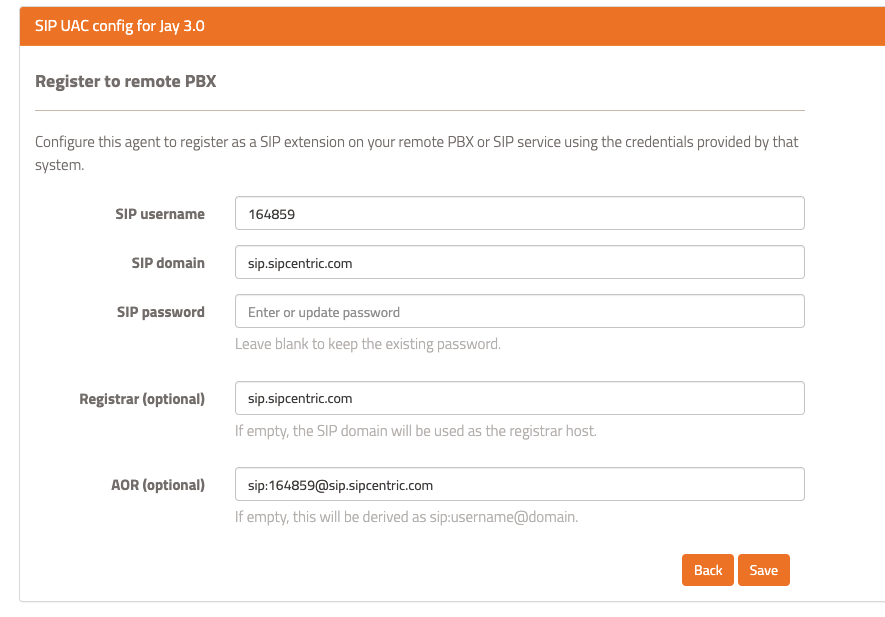
PBX registration
Agents can now register as an extension on your UCaaS platform mimicking a UAC. You give them an extension number and can route calls to them just as you would a human – simple transfers, IVR, or DDIs.
Call control
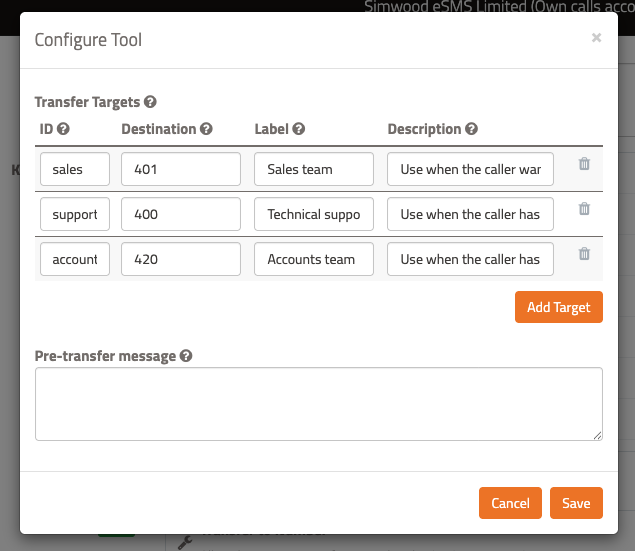
Agents can be given a curated list of permitted extensions and guidance on when to use them. This means they can have more useful conversations before transferring a call to “Jake in Accounts” (as all our test calls seem to need to) if the matter (described in plain English) justifies it. Extensions not on the list cannot get calls so this isn’t a vector for sales scrotes to harass people but it is a vehicle for better customer experiences and potentially the complete replacement of IVR or those ‘automated’ keyword recognition things.
Smarter conversations
Conversation is now much more natural. Turn-taking detection actually works – it understands context and the natural flow of a conversation, not just a fixed period of silence. It’s lower latency as a result, so single word responses like ‘yes’ seem processed much quicker. Finally, speech-to-text is radically more capable of handling environmental issues and is as accurate as the best models. Give it a go!
Retrieval‑Augmented Generation (RAG)
RAG is the memory of an AI agent to provide context to a prompt before it is handed off to an LLM which simply could not handle being given an entire book or knowledge base. The RAG is like a search engine extracting key chunks of text relevant to the question so it is absolutely mission critical for an accurate response. And you know what? They’re generally absolutely crap and severely limited. In the big commercial providers we’ve tested they drastically restrict the size of documents which can be indexed, do so infrequently so they’re out of date and consequently give pretty poor results leading to hallucinations (where the LLM just makes stuff up). We’ve made that so much better and it is all on-net for data privacy and sovereignty – not to mention economics: no megacorp-ready upsell for half a job here.
Now, when you specify URLs to be indexed, they are, properly. Furthermore, one of the new “tools” you can add to your agent is “web search”, triggering a live search to augment results. This crucially passes the “Pete Farmer” test, where someone intellectually vain can phone up and the agent actually knows about their latest blog post.
Put this together and you have an agent which is much more accurate. Note below how it uses both RAG and web search behind the scenes:

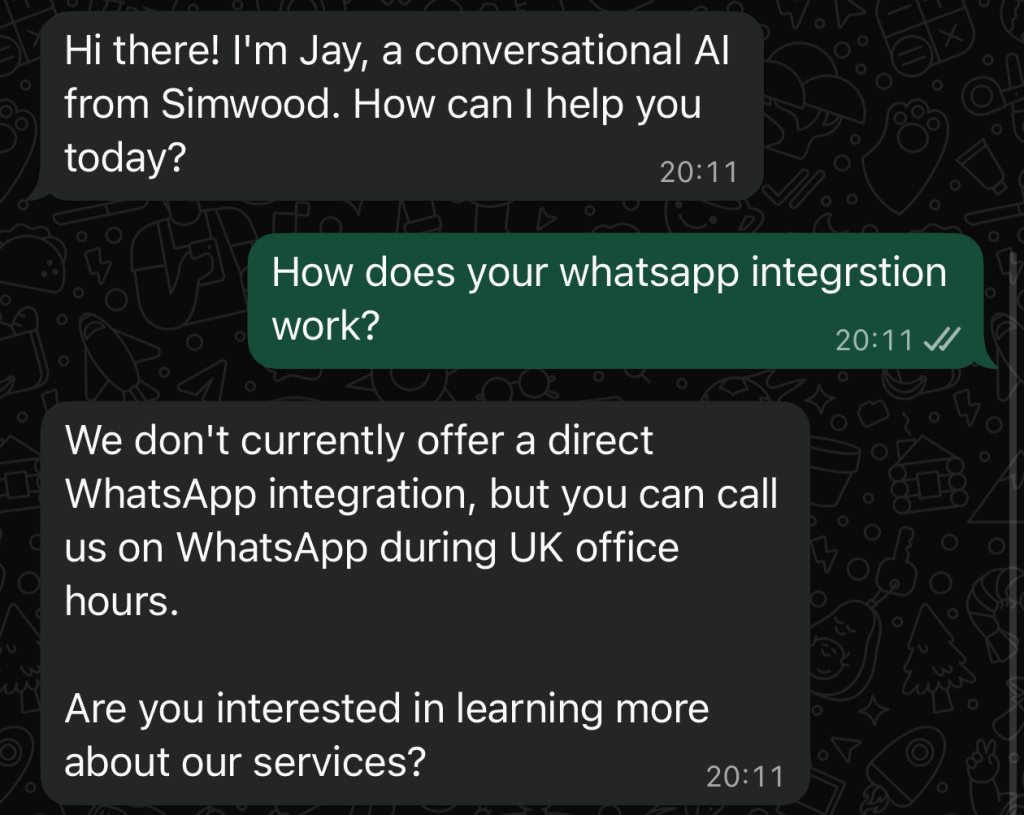
Now check out these old and new WhatsApp chats for an example:
OLD
NEW
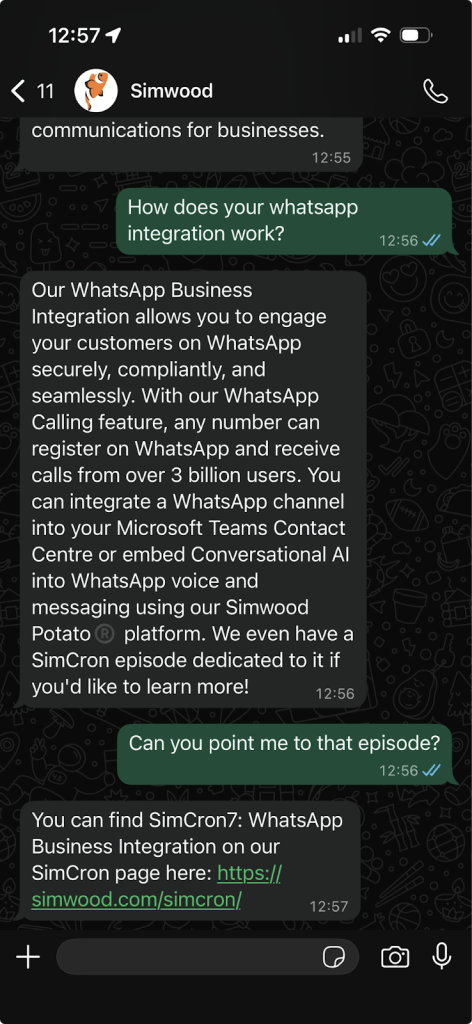
More relevant, and simply better.
Tools
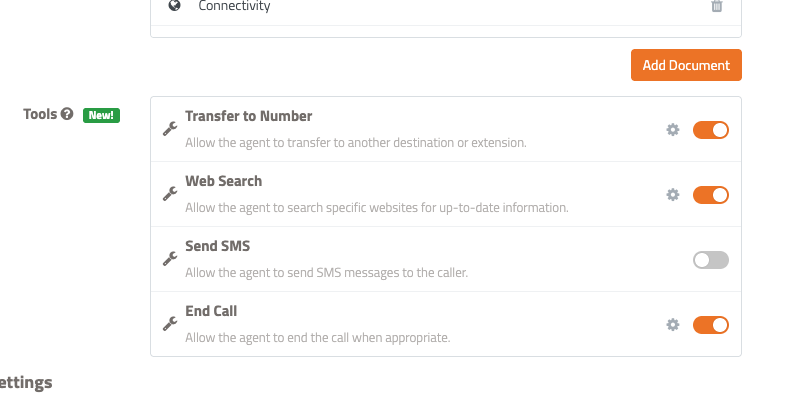
As hinted, we’ve added some tools which you can deploy to agents. These include live web search, and limited sending of SMS, but also call control (mentioned above) – blind transfer or call termination. Attended transfers are coming soon and we have a long list of additional tools to add to make agents more interoperable and powerful.
Speed
With more on net, rather than wanging requests round the planet to random cloud providers, running Anycast in every Simwood Availability Zone and key functions potentially running on our edge, agents are potentially much lower latency (the number one issue developers face) although we know we’ve introduced a lot of functional latency which we’re now working to reduce over the coming weeks.
Coming soon
We described this as a pause in order to then move faster and that is how it is panning out. Having complete control means we can move fast and light, and iterate more quickly. Coming this quarter you’ll see external integrations (MCP-style tools) so the agent can tap into your or your customers’ systems as well as third party services. You’ll also see dynamic variables, attended transfers and the long awaited (for me) call tagging and sentiment analysis on which a few game-changers depend. And maybe a few more things 🙂
Think of this as a reset. A Simwoodification of a minimum viable product which you seem to love and be demanding more from, enabling us to execute the craziest ideas quickly.
Beta testers
No existing agents have been harmed in this refactor – they are now labelled “legacy” in the portal. Any new agents created with be v2. Agents remain in beta (despite the refactor earning the v2) but please play with them in your own test cases and product ideas.
***
We’re now at the beginning. Engines ready!