
Raj wrote last week that the fastest route to market is partnership rather than building everything yourself, and he is right. That leaves the question of who, because “partner rather than build” assumes there is a partner available. Ask a good part of this industry to partner with you and what comes back is a rate sheet.
There are two tests. Capability: do they have what you need, already built, or are you going to build it? Alignment: does their growth depend on winning the same end customers you are trying to win? They are independent, and a supplier has to pass both.
The capability test
If all your supplier sells is lines and minutes, you are going to build everything else. The fraud controls, the number management, the recording, the analytics, the AI layer your customers have started asking about and your roadmap has already slipped. You will build all of it while paying a company whose job it was to have built it once, properly, for everybody.
They are not withholding a roadmap out of spite. I wrote about this two years ago and I would struggle to point at much that has changed since. The people who sold lines and minutes in the nineties are selling the same thing over SIP.
Before you get that far, check whether they have any infrastructure at all. A good number of the companies calling themselves carriers are reselling somebody else’s, and this is the UK, where it is reseller on reseller on reseller. If that is your situation there is a chain behind your supplier and you probably cannot see the top of it. You know who invoices you, which is not the same as knowing whose network you are on.
The alignment test
Now ask where the money you pay your supplier goes. If they also sell direct, or through partners of their own, it goes into a business competing for the customers you are chasing. They can also see your volumes, your growth and your seasonality, because carrying your traffic is how they find out, and in some arrangements they can see which of your end customers holds which number. Some of it you hand over deliberately, because you have to: emergency service records and porting requests are the obvious examples. The rest accumulates as traffic flows and numbers are allocated and ported. Either way your supplier holds a current picture of who your customers are and which numbers are theirs, and no step of it ever felt like handing over a customer list.
None of this requires anybody to behave badly. It is structural.
And it is not only your immediate supplier. In a chain, the conflict may sit two layers above the logo on your invoice, with an operator you have never contracted with, who can see your traffic because it passes through them, and who is chasing your customers with a sales force you have never met. Your supplier may be entirely innocent and entirely powerless, which does not help you.
Now try saying all of that out loud to your NED, your PE backer or your VC. Our strategy is to take share from that company. We fund them out of what our customers pay us. They can see who our customers are. And they turn up across the table in our own pitches. Nobody defends that arrangement out loud, which is why it survives: it is never said to anyone whose job is to ask.
Where we sit, and what it has cost us
The question underneath the alignment test is whose platform the service runs on: yours, in which case you buy carriage and numbering and build the rest yourself, or your supplier’s, sold either under your brand or under theirs. Everyone in this market sells some of each. The weighting is the thing, so here is ours next to our purple radioactive friends’, cut on that axis.
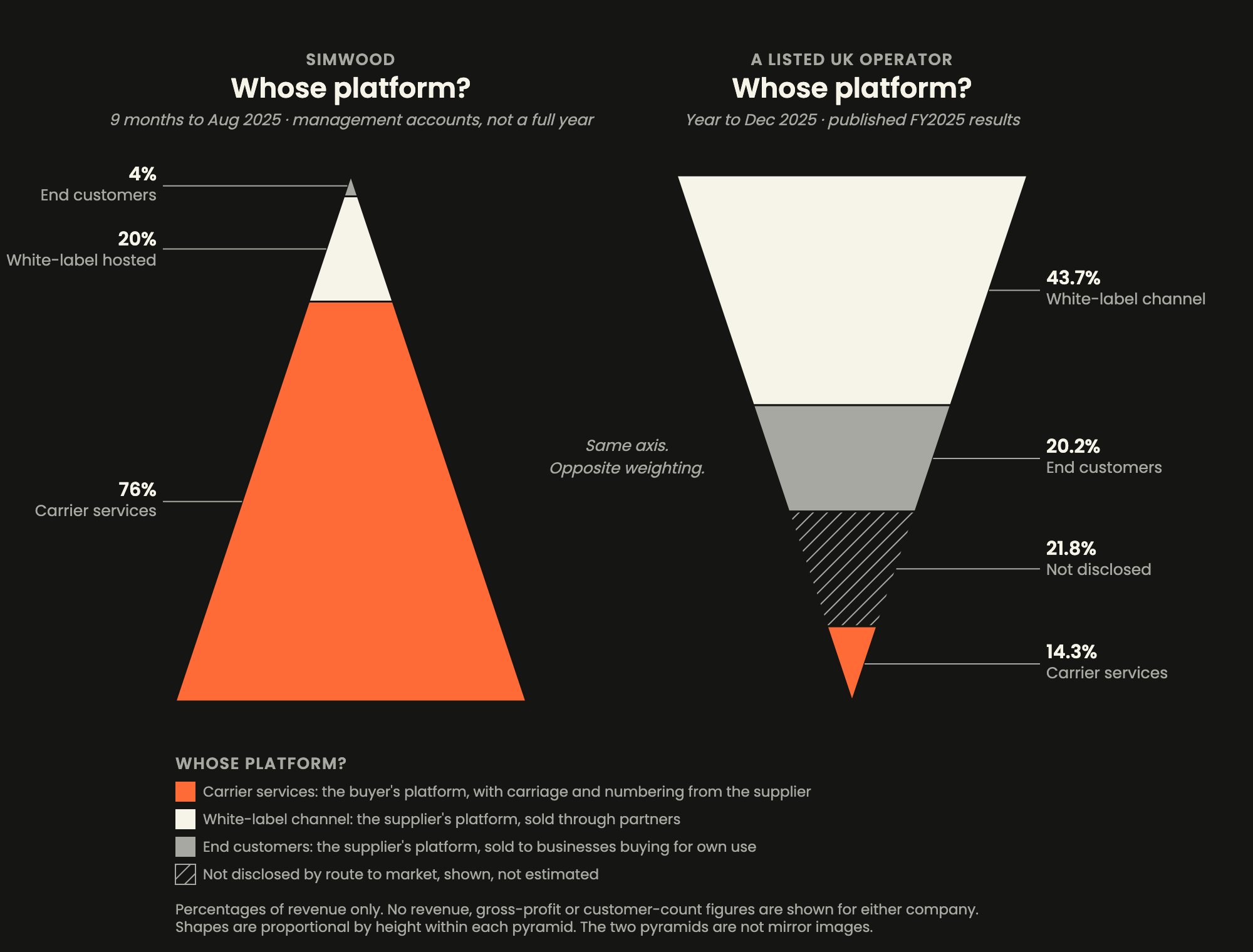
The white-label band in the middle of ours is our platform, sold through partners. It is fully white-labelled, but every supplier says that. The end customer sees your name on the product, the portal, the invoice and the support. We send through your own SMTP servers, so we do not appear in the mail headers. Our apps are named anonymously enough that a good number of the people using them do not know they exist as our products at all.
We want no inbound from those end users and no word of mouth, which is why it is built this way. Years of product work has gone out under other people’s names, and the recognition it earned sits with our customers rather than with us. That is the cost, and we keep choosing it.
Our engineering goes into the layers underneath: the fraud controls, the numbering, the recording, the nuisance call handling that protects your customers’ customers, and the Conversation Intelligence and AI voice work Charles’s team has shipped. You put your own name on all of it.
What we build carries no trace of us to the end user, and the relationship goes to whoever sold it. We have done that for years. That is not a claim to be incapable of anything else: there is a direct band on that graphic, and we hold your traffic data, as does anyone carrying it. Weigh the record rather than the promise.
So
Email your largest supplier today and ask, in writing, whose network your traffic ends up on, who else is in the path, and what they are building next year that you are currently scoping to build yourself and already paying them for.
It is a fair question from a paying customer. If what comes back is a rate sheet, you have your answer to both tests.
Then ask us the same thing.